
In short: We explain how splitting a network into VLANs boosts security and order across your IT infrastructure.
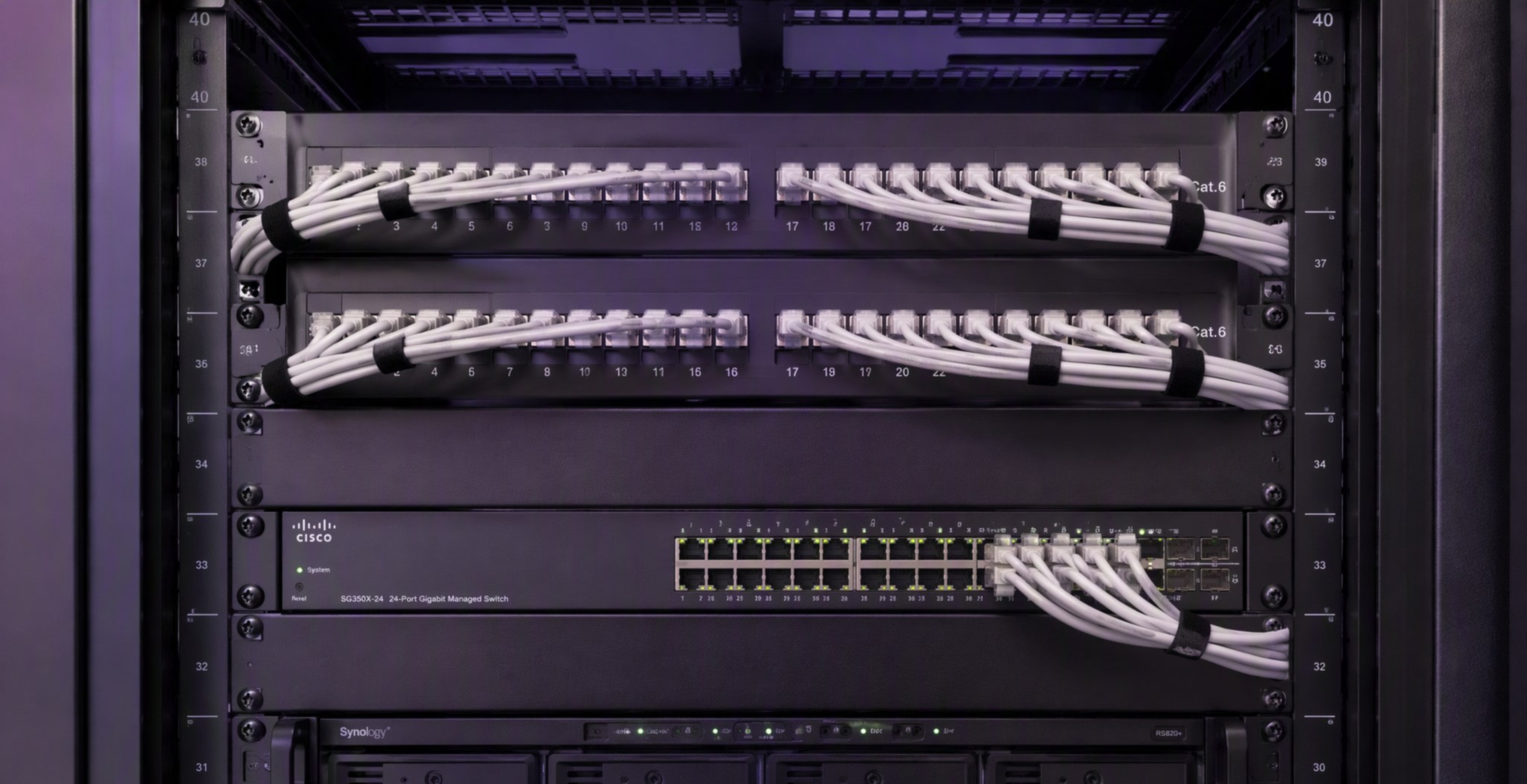
In many small and mid-sized companies, every device — employee computers, printers, IP cameras, phones, and sometimes even the guest network — runs on one shared network. That's convenient at the start, but as the company grows it becomes a source of security and performance problems. Here's what a VLAN is and how segmentation brings order to network infrastructure.
What Is a VLAN
A VLAN (Virtual Local Area Network) is a way of logically dividing a single physical network into several independent virtual networks. Devices on different VLANs can't see each other directly, even when connected to the same switch — communication between them has to pass through a router or firewall, where it can be controlled and filtered. Technically, this is achieved by tagging network frames according to the 802.1Q standard, which allows a single cable (known as a trunk) to carry traffic for multiple VLANs at once.
Most Common Uses in a Business
- Guest network — visitors and contractors get internet access without reaching internal company resources such as servers or network printers.
- VoIP telephony — separating voice traffic from data traffic reduces the risk of network congestion and makes it easier to prioritize voice calls.
- IP cameras and security systems — isolating them from the office network limits the risk that a poorly secured IoT device becomes a gateway into the rest of the infrastructure.
- Servers and critical resources — access to the accounting department or server room can be restricted to selected VLANs, regardless of where the workstation is physically located.
What's Needed for Implementation
VLAN segmentation requires managed switches that support the 802.1Q standard, along with a router or firewall capable of routing between virtual networks (so-called inter-VLAN routing). On the wireless side, you additionally need access points that support multiple SSIDs, each of which can be assigned to a different VLAN — that way, a single physical device can simultaneously serve both the company network and the guest network while keeping the traffic fully separated.
Rule of thumb: the more diverse the types of devices on a network — computers, phones, cameras, printers, AV systems — the greater the benefit from VLAN segmentation; in a small, uniform office network, its absence tends to be less painful.
Summary
VLANs aren't an extra reserved for large corporations — they're a fundamental organizational tool that, at a reasonable cost, significantly boosts the security and clarity of a company network. It's best to plan segmentation right from the network design stage, though it can just as well be introduced into an already-running infrastructure — that just requires carefully sequencing the changes so the company's work isn't disrupted.
Read also: Cisco