
In short: We compare two approaches to covering a larger office space with signal.
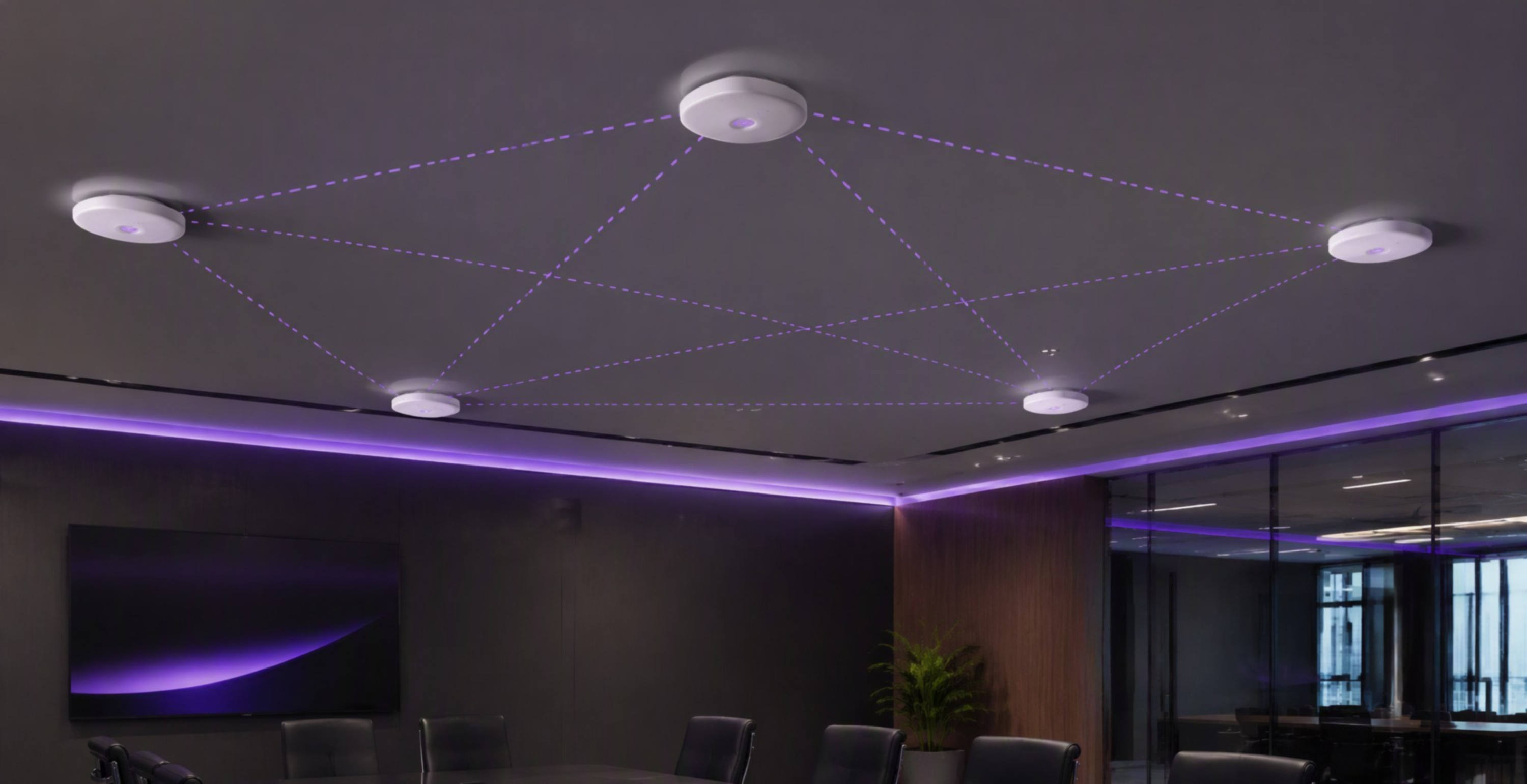
In a large office, a single router or access point sooner or later stops being enough — weak-signal zones appear, connections drop as people move between rooms, and employees get frustrated. We look at when the answer is a distributed network with multiple access points, and when a single, well-chosen device is all you need.
How a Mesh Network Works
A mesh network consists of several access points working together under one shared SSID. A mobile device automatically connects to the nearest, strongest node and hands off between them seamlessly as the user moves through the building. In consumer setups, mesh nodes connect to each other wirelessly, which is convenient for installation but reduces available throughput, since part of the radio bandwidth is consumed by communication between the nodes themselves. Business-grade solutions favor a wired backhaul — each access point is connected to a switch with its own cable, which eliminates that problem and delivers a much more stable network overall.
When a Single, Well-Chosen Access Point Is Enough
Smaller, single-story offices without thick reinforced-concrete walls or many obstacles often don't need an elaborate infrastructure. One good-quality access point, placed centrally, can successfully cover a fairly large office floor. Installing several unnecessary points in such a case not only adds needless cost but can actually degrade network quality through mutual interference on the same channels.
Pros and Cons of Both Approaches
- Multi-AP network — even coverage of a large or multi-story space and seamless roaming between points, but it requires careful planning and usually structured cabling to every access point.
- Single router/AP — simplicity, low cost, and easy setup, but limited range and a single point of failure — when the device goes down, the whole network goes with it.
- Centralized management — professional multi-point systems let you monitor the load on individual access points and react before users notice a problem — a capability simple home routers lack.
Rule of thumb: the number and placement of access points should follow from the floor plan and the number of users, not from a budget set in advance — adding one access point in the right spot often solves the problem more effectively than replacing all the hardware with a pricier model.
Summary
The choice between a mesh network and a single access point should be driven by square footage, room layout, and the number of people working simultaneously — not by which solution happens to be more popular. In larger, multi-room offices, a multi-point network with wired backhaul almost always delivers better, more predictable results than trying to "light up" the space with one more powerful device.
Read also: Wi-Fi Alliance