In short: We weigh the pros and cons of both solutions across different room sizes and budgets.
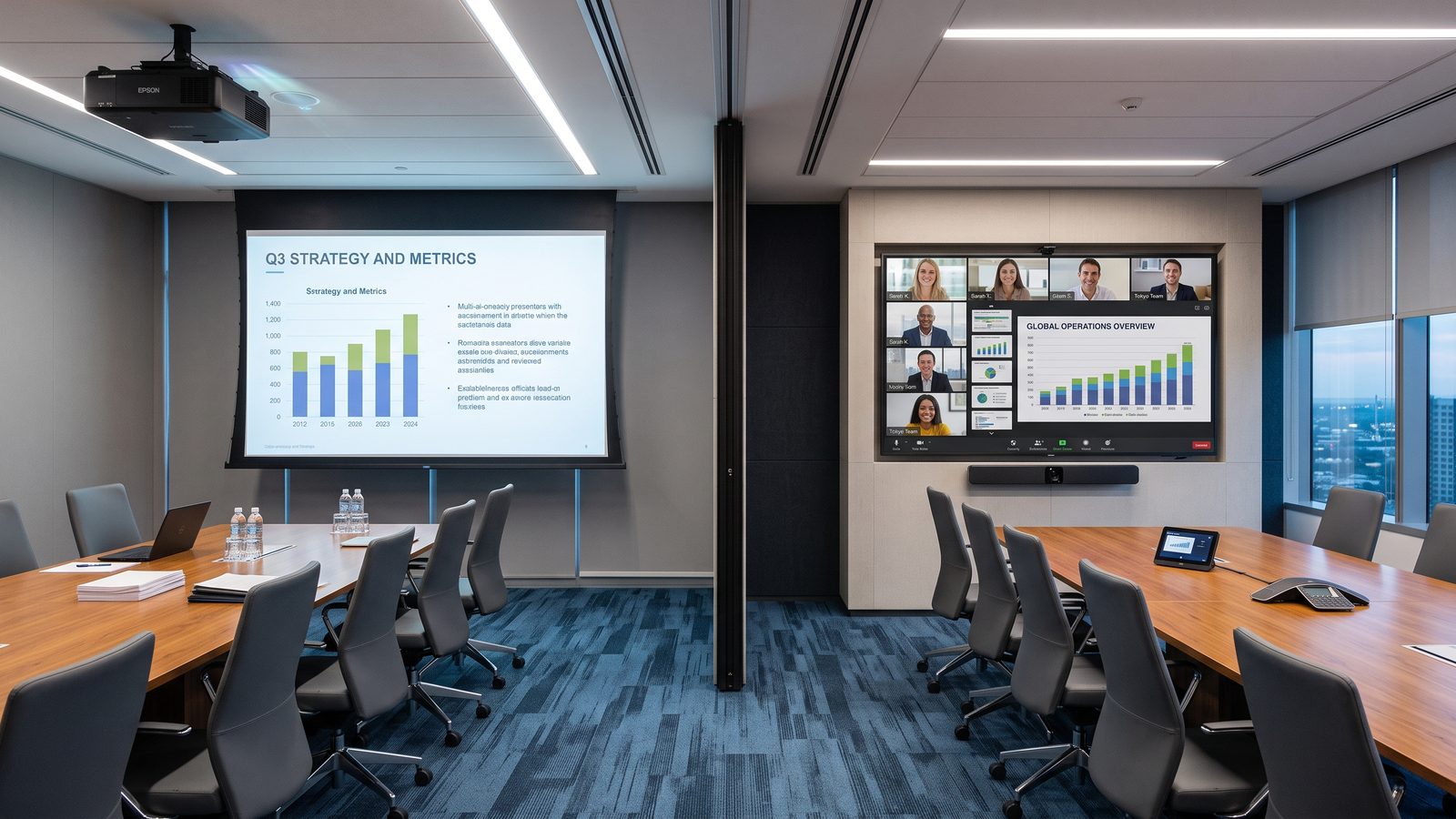
This is one of the first questions that comes up when planning a conference room's equipment — TV or projector. The answer depends on room size, lighting conditions and budget, and a solution that's well suited to one room can be completely wrong for another. We weigh up the pros and cons of both options in a practical context.
TV — simplicity and reliability
A large TV, now available in sizes reaching several metres diagonally, works very well in small and medium-sized conference rooms. Its biggest advantage is independence from lighting conditions — an emissive display stays legible even with full lighting and daylight coming through windows, which can't be said of classic projection. A TV also doesn't need periodic light-source replacement or the level of servicing a projector requires, and installation is usually simpler and quicker.
A TV's limitation is the upper bound on available sizes and cost, which rises non-linearly with diagonal size — very large models quickly become significantly more expensive than a comparably sized projection installation.
Projector — a scale TVs can't match
Wherever a genuinely large image is needed — in bigger conference rooms, training rooms or multipurpose spaces — a projector remains the only practical solution. The projected surface can be matched to the room's size far more flexibly than the fixed sizes available for TVs, and the cost of installing a large projection screen rises more slowly than the cost of an equally large TV.
The downside of projection is its sensitivity to lighting conditions — in bright rooms, especially with large glazed areas, the projected image loses contrast and legibility, unless the projector has adequate brightness reserve or the room is fitted with blackout capability.
Comparison in practice
- Small and medium rooms (up to a dozen or so people) — a TV usually wins on installation simplicity and independence from lighting.
- Large and multipurpose rooms — a projector delivers a scale of image that TVs can't match at a reasonable budget.
- Rooms with a lot of sunlight — a TV is the safer choice, unless the room has effective blackout and the projector has adequate brightness reserve.
- Budget and running costs — a TV is usually cheaper to maintain, while a projector can be cheaper per square metre of image at large sizes.
Summary
There's no single universal answer to "TV or projector" — the decision should follow the actual size of the room, its lighting conditions and how it's used. In practice, a good starting point is assessing whether the room has control over daylight and what image size is actually needed — these two factors usually point to the right direction on their own.
Read also: ProjectorCentral