
In short: We look at when an LED wall makes sense, and when a cheaper LCD panel solution is the better fit.
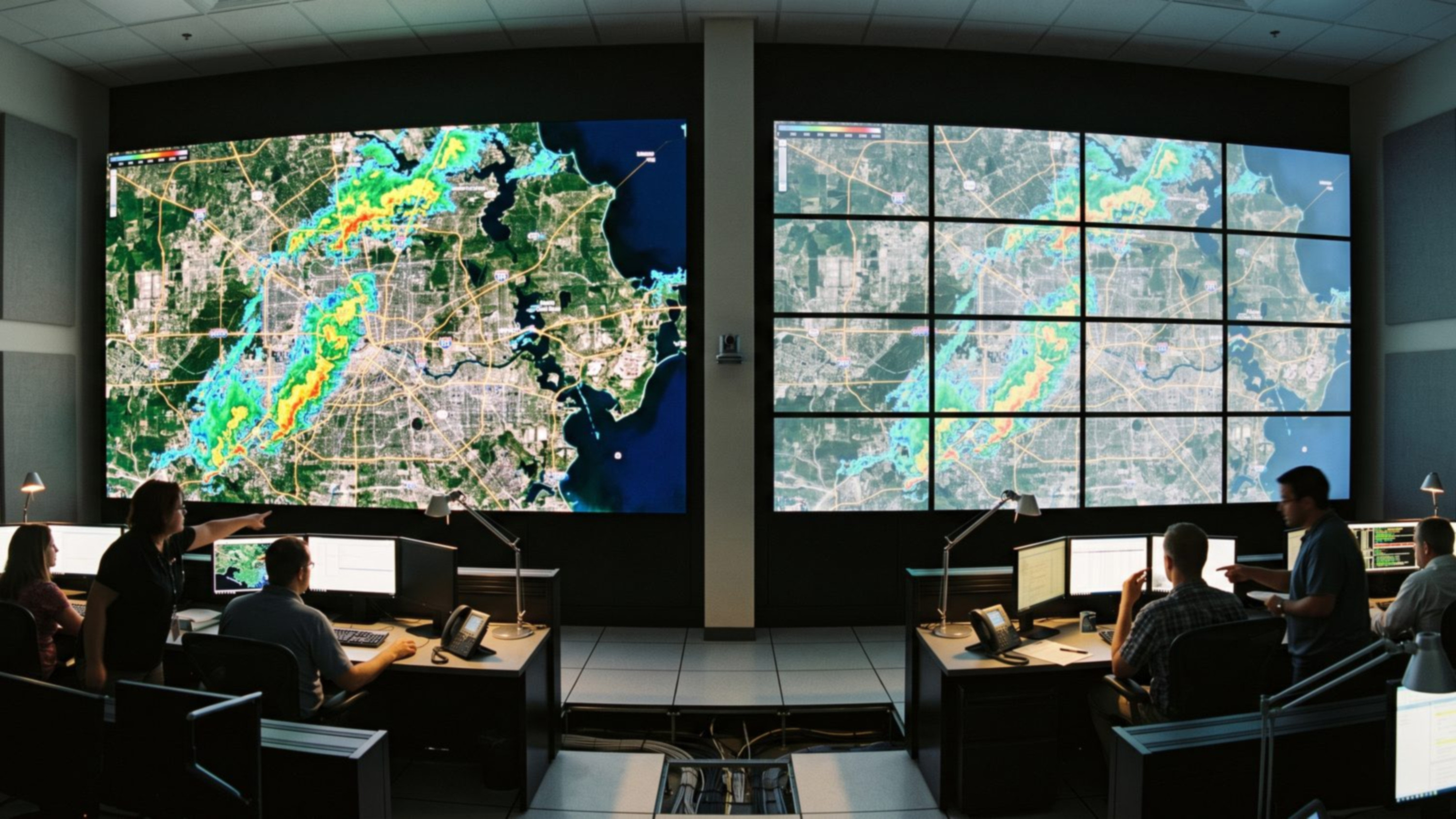
A video wall is an increasingly common feature in receptions, conference rooms and event spaces, but the choice of technology it's built on can significantly affect both budget and the final visual result. We explain how LED walls differ from solutions built on LCD panels, and where each performs best.
LED walls — a seamless image with no gaps between modules
An LED wall is made up of small modules, each containing hundreds or thousands of diodes that form the image. The key advantage of this solution is the absence of bezels between modules — once assembled, the wall forms a single, continuous image surface regardless of its size. This makes LED walls well suited to large, striking installations where the image needs to make an impact right from the entrance, for example in receptions or event spaces.
An important parameter for LED walls is pixel pitch — the distance between neighbouring diodes — the smaller the value, the higher the image density, and the closer a viewer can stand without losing image quality. Pixel pitch selection should always take the typical viewing distance into account — too "coarse" a pixel, viewed up close, will show up as a grid rather than a smooth image.
LCD panels — a proven solution on a lower budget
A video wall built from LCD panels (a so-called video wall matrix) consists of individual screens joined into a grid, e.g. 2x2 or 3x3. This solution is usually cheaper than an LED wall of comparable size and works well where the image is viewed from some distance and the project budget is limited. The downside is a visible — though increasingly narrow in modern models — bezel between panels; up close it becomes a noticeable part of the image, especially when content is stretched across the whole surface.
Which solution to choose, and when
- Receptions and lobbies — an LED wall, thanks to the lack of visible gaps and the freedom to choose any surface format.
- Conference rooms on a limited budget — an LCD matrix, if the image is viewed from an appropriate distance.
- Event and stage spaces — an LED wall, thanks to its size flexibility and ability to run continuously for many hours.
- Smaller-scale digital signage — single screens or small LCD matrices, where investment cost matters more than a "seamless" surface effect.
Summary
Choosing between an LED wall and an LCD matrix comes down to three questions — what's the project budget, from what distance will the image be viewed, and how large and unusual should the final display surface be. LED offers more freedom and a better result up close, while LCD remains a sensible compromise where cost matters and the viewing distance is enough to hide the bezels between panels.
Read also: Planar