In short: We translate projector spec sheets into practical terms to help you pick the right model for your room.
A projector's spec sheet can be overwhelming — lumens, contrast, resolution, screen gain, throw ratio. Yet making a good decision requires far less specialist knowledge than data sheets suggest. In this article we explain which parameters genuinely affect picture comfort in a conference room, and which are largely marketing add-ons.
Brightness in lumens — the most important practical parameter
A projector's brightness, given in ANSI lumens, determines whether the image stays legible with the lights on and daylight coming through the windows. This is the parameter that deserves the most attention, because underestimating it is the most common mistake when buying equipment for meeting rooms.
- Rooms with no windows or with blackout blinds — a projector in the range of a few thousand lumens is usually enough.
- Rooms with large glazed areas — it's worth planning a clear brightness reserve, because in practice daylight "washes out" image contrast much faster than the spec sheet alone would suggest.
- Large screens — the bigger the image, the more lumens are needed to maintain the same perceived brightness per square metre of surface.
A good habit is to plan brightness with a margin rather than cutting it close — a lamp or laser diode loses some of its original brightness over its service life, so a safety margin pays off after a few years of use.
Contrast — a parameter that's hard to compare on paper
Contrast describes the difference between the darkest and brightest point of an image, and largely determines whether a presentation with a dark background stays legible or blends into grey. The problem is that manufacturers measure contrast in different ways, so comparing raw numbers between models can be misleading. In practice it's better to judge the actual image under conditions close to the intended use than to rely solely on a spec-sheet figure.
Resolution — match it to the content, not the trend
Higher resolution makes sense where detailed content is actually displayed on screen — spreadsheets, technical drawings, dense tables. In a typical conference room, dominated by presentations and video calls, well-chosen brightness and contrast affect viewing comfort more than pixel count alone. It's also worth remembering that projector resolution should match the resolution of the sources the room actually uses — otherwise the difference stays on paper only.
Throw ratio and mounting position
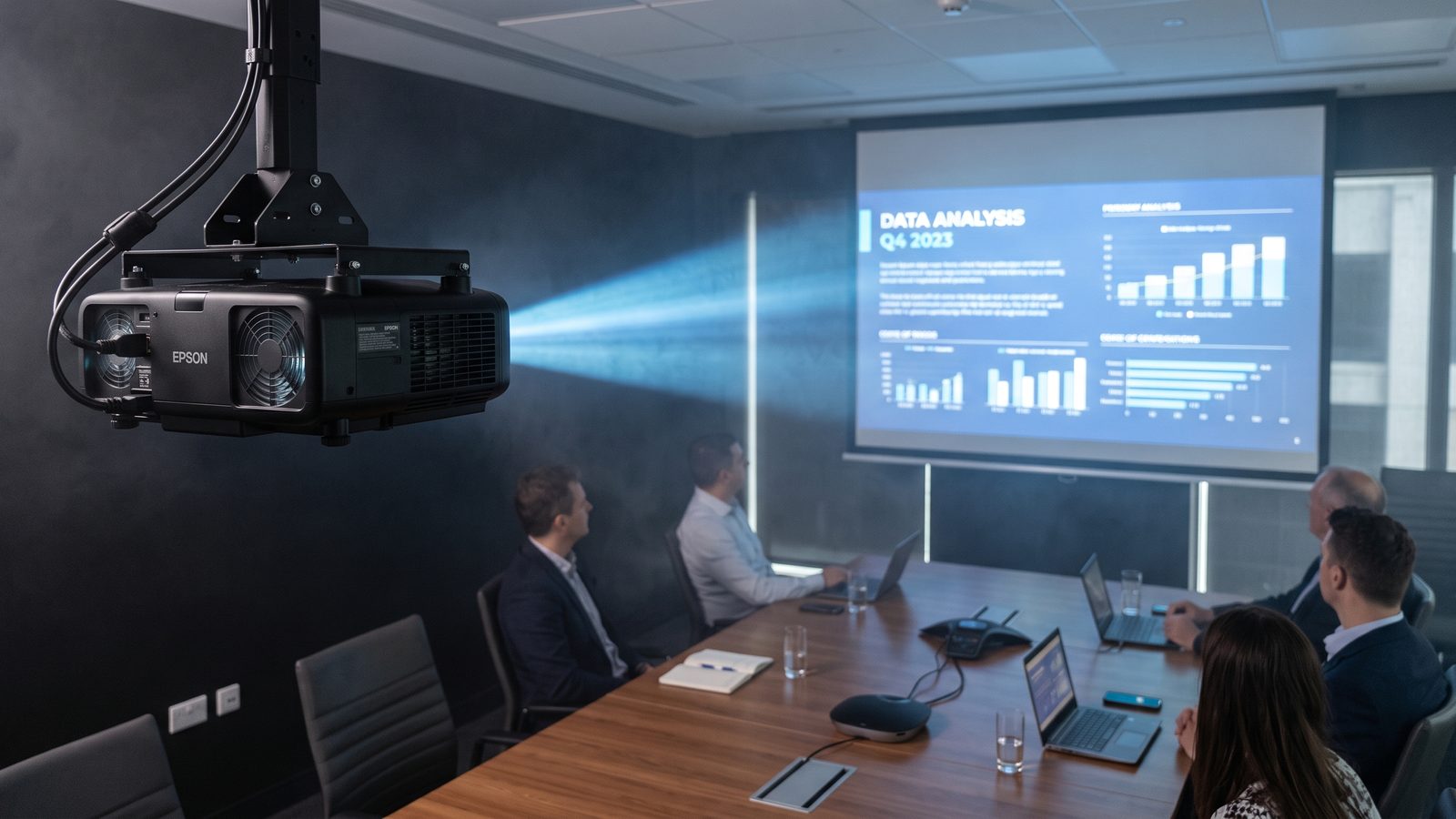
Throw ratio describes the relationship between the projector's distance from the screen and the width of the displayed image. It has a direct impact on where the unit can physically be mounted in a given room — short-throw projectors work well in smaller rooms with no space for a classic ceiling mount far from the screen. This parameter is worth confirming with the installer before purchase, because getting it wrong can rule out a particular model for a given room, regardless of its other merits.
Summary
Choosing a projector for a conference room mainly means matching brightness to lighting conditions and screen size, and only then comparing contrast and resolution. The best results come from evaluating equipment under conditions close to real-world use, plus a consultation with an installer who will account for the room's geometry and how it is used.
Read also: ProjectorCentral