
In short: The basic principles of designing cabling and LAN topology for a business environment.
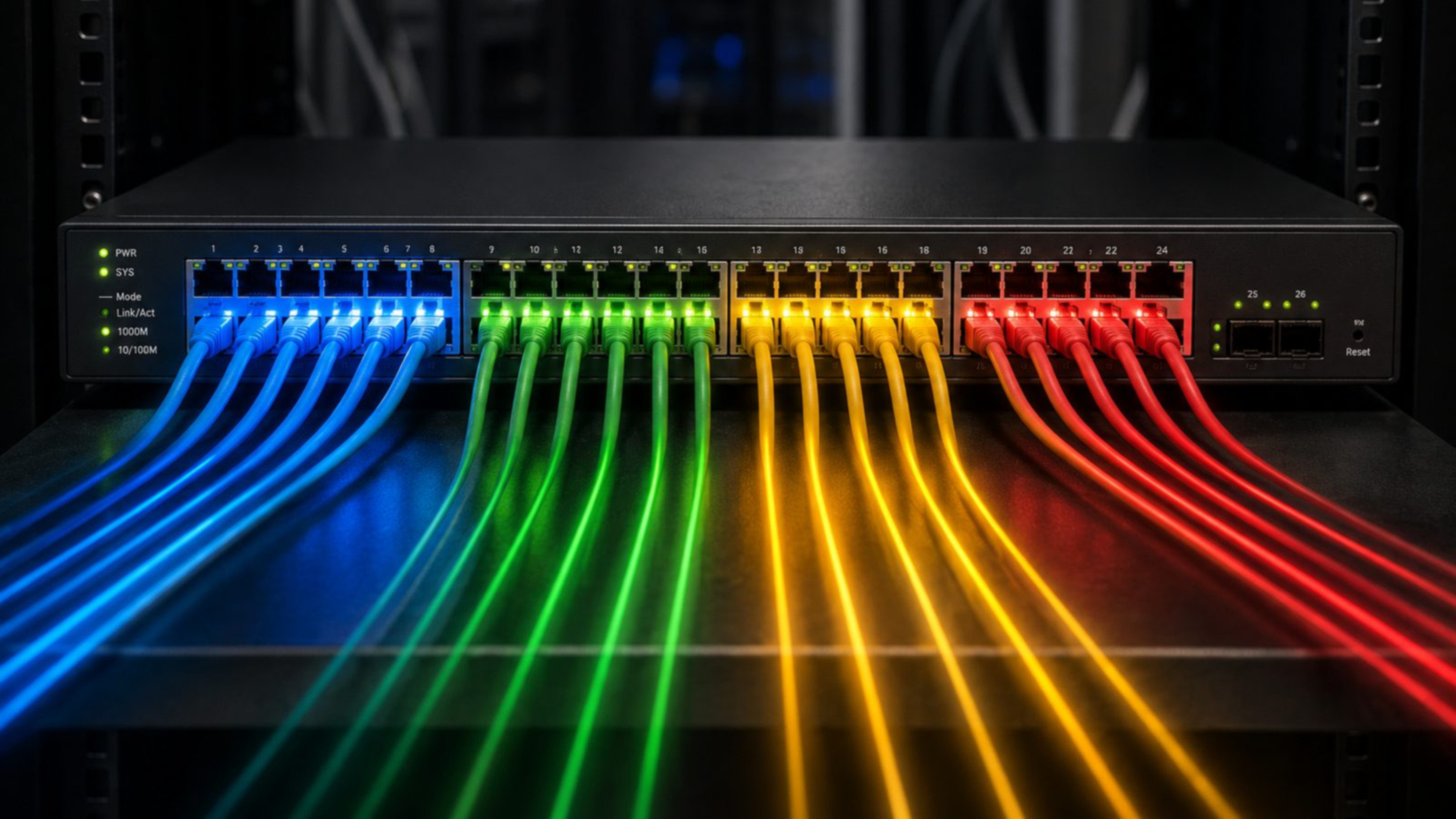
The LAN is the backbone that a company's day-to-day work rests on — from internet access, to IP telephony, to AV systems and cameras. Mistakes made at the cabling and topology design stage are difficult and costly to fix once a company has already moved into the office. Here are the fundamental principles worth factoring in at the planning stage.
Star Topology and the Central Point
Modern LANs almost always rely on a star topology — every network outlet in a room runs on its own cable back to a central distribution point, where the switches and patch panel live. This makes fault diagnosis easier, since a problem at one workstation doesn't affect the rest of the network, and it lets you easily add new outlets as the company grows. In larger, multi-floor offices, a backbone additionally connects the distribution points on each floor to the main server room.
Choosing Cabling and Distribution Points
The foundation of any installation is structured cabling compliant with the PN-EN 50173 standard, which sets out cabling classes and requirements for individual installation components — from cables, to outlets, to patch panels. Worth considering at the planning stage:
- Cable category — Cat6 or Cat6A is becoming the standard in new installations, providing a throughput buffer for years to come.
- Number of outlets per workstation — the practice of two outlets per desk (data and telephony, or a spare) makes later rearrangements easier without additional construction work.
- Location of the distribution cabinet — it should be as central as possible relative to the area it serves, given the maximum copper cable length of 100 meters.
- Ventilation and power for the rack cabinet — switches, especially PoE ones, generate heat and draw power, which needs to be factored in when planning the technical room layout.
Designing with the Future in Mind
A good LAN is one that doesn't need to be rebuilt with every organizational change. It's worth planning a reasonable buffer of free switch ports beyond current needs, running extra technical cabling to locations earmarked for future cameras or access points, and segmenting traffic logically with VLANs from day one, rather than retrofitting that segmentation onto a live network later.
Summary
Designing a LAN for an office is about far more than deciding how many wall outlets to install. A well-thought-out topology, compliance with structured cabling standards, and room for future growth mean the infrastructure serves the company for years, rather than becoming a source of problems within a few months of use.
Read also: Cisco