
In short: We show how to design a network resilient to a single internet provider's outage.
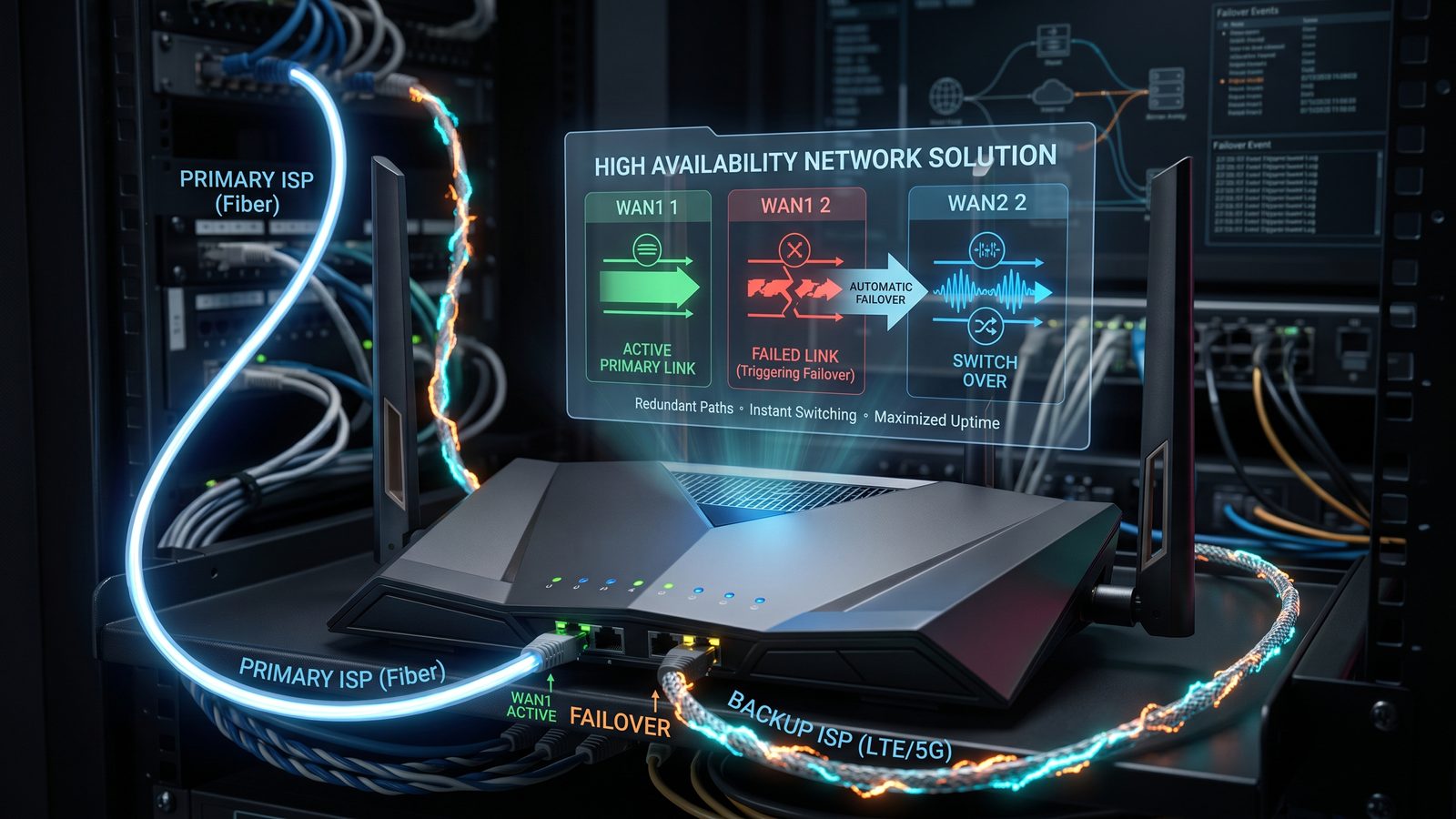
An internet outage can paralyze an entire company's operations — from losing access to email and cloud systems to being unable to run a video call with a client. And yet many offices still rely on a single connection from a single provider, hoping an outage simply won't happen. Here's how to design a network resilient to exactly that situation.
Why One Connection Isn't Enough
Even the best internet provider can't guarantee 100% service availability — infrastructure failures, maintenance work, or a cable damaged outside the company building are all outside its control. The scale of the problem depends on the nature of the business: a design studio might survive a few hours' outage, but a contact center, an online store, or a team working in the cloud loses real money with every minute of downtime.
Redundancy Models
Internet connection redundancy can be implemented in several ways, each differing in cost and complexity.
- Failover — a secondary connection stays on standby and only takes over traffic automatically if the primary one fails. A simpler, cheaper option, requiring a router capable of automatic switchover.
- Load balancing — both connections work simultaneously, splitting network traffic between them. This makes better everyday use of available bandwidth but requires a more advanced router configuration.
- SD-WAN — an enterprise-class solution that intelligently routes different types of traffic over whichever connection is best suited at a given moment — for example, sending video conferencing traffic over the lower-latency link.
Choosing the Second Connection
Redundancy only makes sense when both connections can fail independently of each other. Choosing two fiber connections from the same provider, run along the same cable route into the building, offers no real protection in practice — a single damaged underground cable can knock out both at once. A better approach is combining two different technologies, for example a fiber connection as the primary link and a mobile connection (LTE/5G) as the backup, or two independent providers relying on separate infrastructure.
Summary
Internet redundancy is an investment whose cost is easiest to justify only after the first serious outage — by which point it's already too late to avoid the losses. It's worth treating a second connection as a piece of business-continuity insurance, sized in proportion to how much the company actually loses for every hour of downtime.
Read also: MikroTik