
In short: The differences between Cat6 and Cat6A and their impact on throughput and future-proofing.
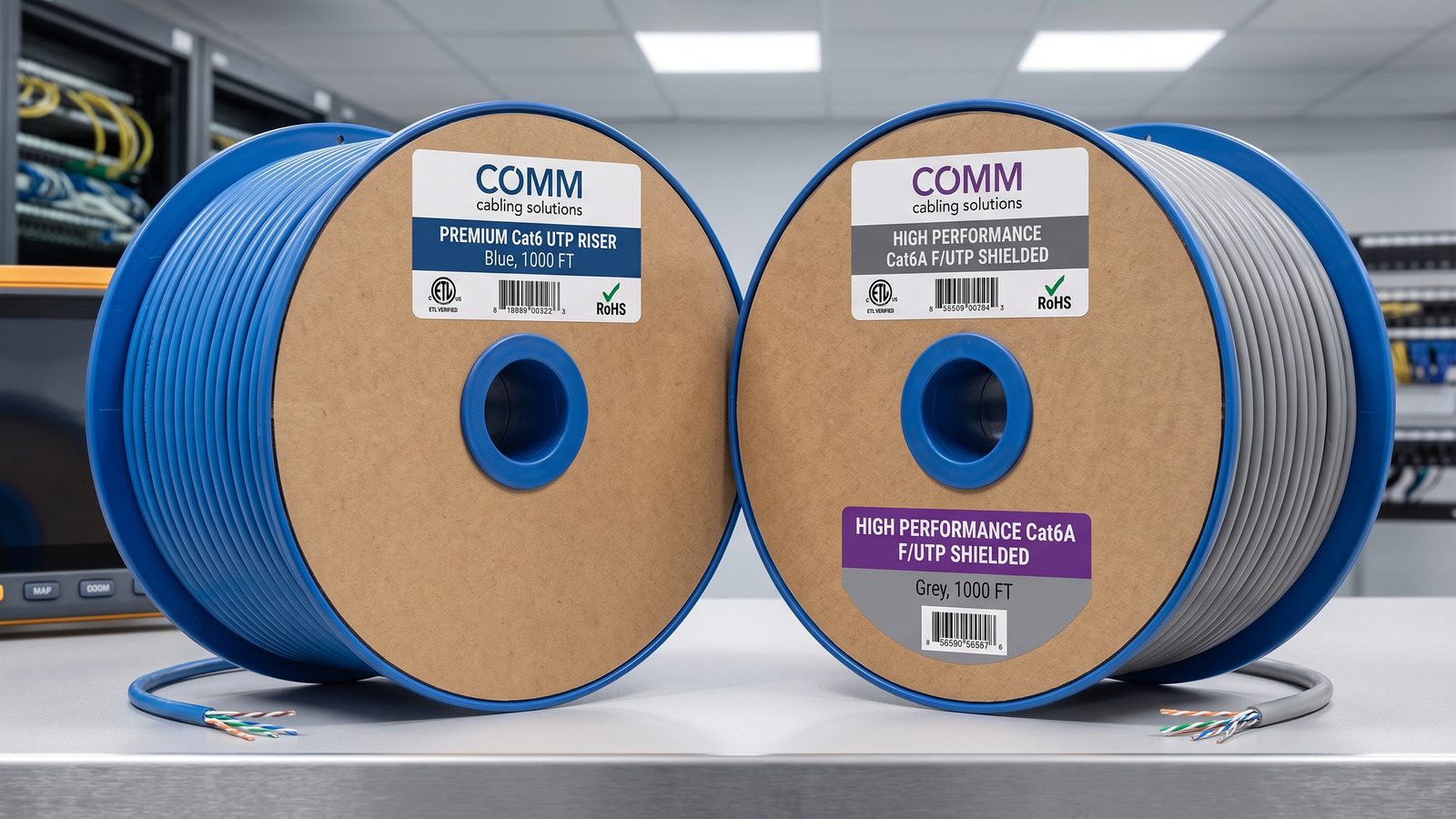
Choosing a structured cabling category is a decision that will affect a company network for the next decade or longer — cables are usually run inside walls and under floors, so replacing them means construction work. We look at how the popular Category 6 and 6A cables differ today, and when it's worth paying extra for the higher standard.
Technical Differences Between Cat6 and Cat6A
Both categories of twisted-pair copper cable support 1 Gb/s without restriction over the full 100-meter distance. The difference shows up at higher throughputs: Cat6 cable supports 10 Gb/s (10GBASE-T) only over a shortened distance and is more susceptible to alien crosstalk between neighboring cables when cable trays are densely packed. Cat6A cable operates at a higher frequency, has a thicker cross-section, and often additional shielding, so it supports the full 10 Gb/s over the entire permitted 100-meter distance — at the cost of a larger diameter, more weight, and a higher price.
When Cat6 Is Enough, and When Cat6A Is Worth the Investment
- Typical office workstations — Cat6 is more than sufficient for computers, printers, and IP phones, since per-workstation bandwidth demand rarely exceeds 1 Gb/s.
- Backbone links and the server room — connections between switches, to access points supporting newer Wi-Fi standards, and to servers benefit from Cat6A, which provides bandwidth headroom without needing to move to fiber.
- Densely packed cable trays — in installations where cables run in large bundles, shielded Cat6A handles interference between conductors better.
- Budget and future-proofing — if an installation needs to serve for many years with no plans to replace the cabling, the premium for Cat6A can end up cheaper than a later upgrade.
The PN-EN 50173 Standard and Cabling Classes
The Polish PN-EN 50173 standard, the local equivalent of the European structured cabling standards, defines classes of transmission links and requirements for installation components — cables, outlets, patch panels, and cable routes. Designing an installation to this standard makes certifying the network after completion easier and ensures that every component — from the wall outlet to the switch port — is compatible and delivers the intended transmission parameters.
Summary
In most offices, Cat6 cabling remains a sensible, economical choice today. Category 6A makes sense where the network is planned to expand with devices requiring higher throughput, or where the cabling needs to stay relevant for a significantly longer period without another round of construction work.
Read also: Fluke Networks