
In short: We look at how the newest display technologies differ and where each one is best applied.
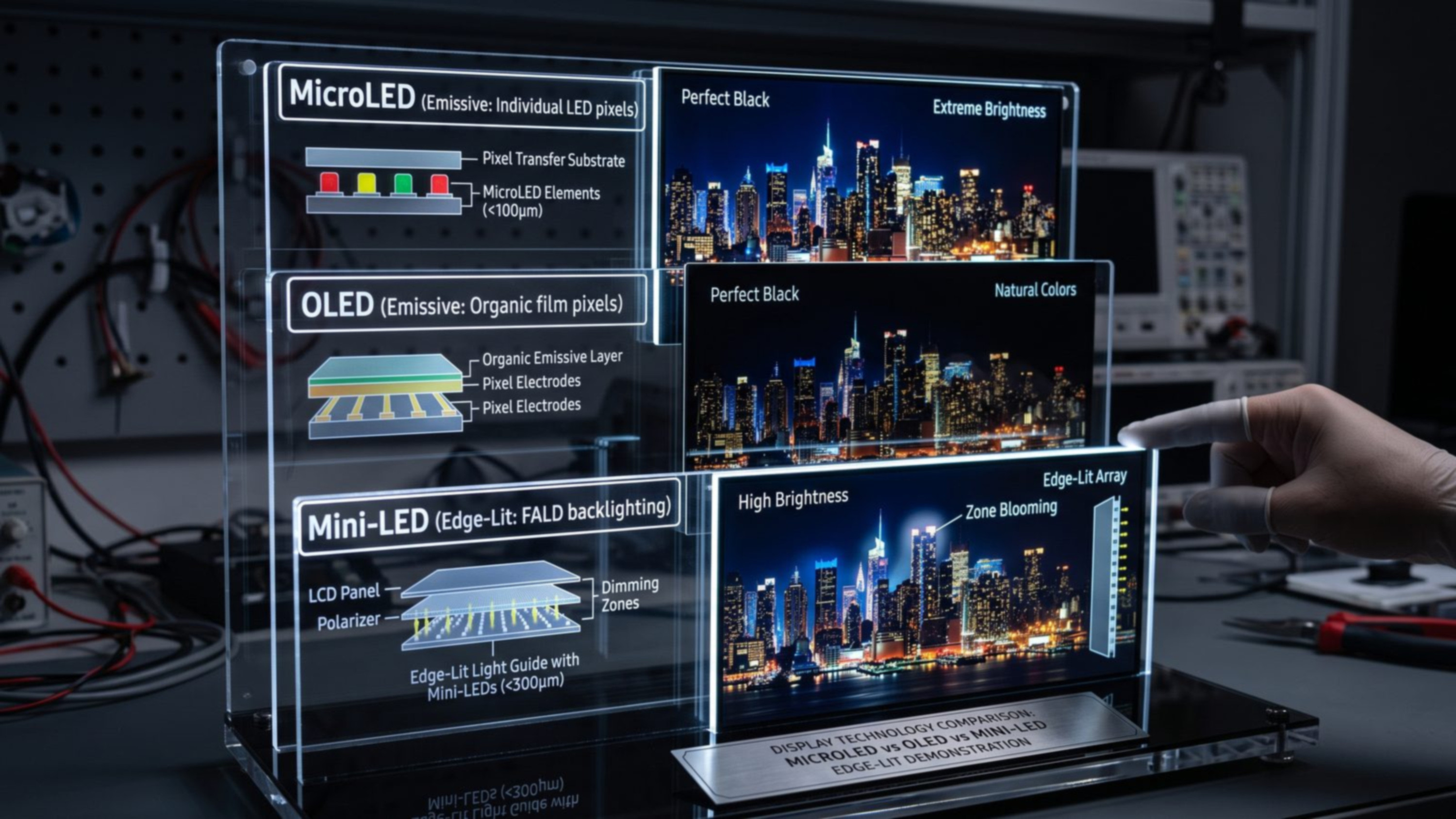
The display market is evolving faster than ever, and names like MicroLED, OLED and Mini-LED increasingly appear side by side in product lineups for offices and conference rooms. We look at what actually separates these technologies and where each performs best.
OLED — deep black and near-perfect contrast
In OLED technology, each pixel emits its own light and can be switched off completely, independently of neighbouring pixels. This gives OLED screens exceptionally deep black levels and very high contrast — there's no backlight "bleeding" through dark parts of the image, a phenomenon typical of classic LCD panels. The downside of this technology is the risk of image burn-in when static elements, such as a logo or a navigation bar, are displayed for long periods — something that matters for digital signage applications, where a screen runs many hours a day with repetitive content.
Mini-LED — a refined LCD backlight
Mini-LED isn't a separate panel technology — it's an improvement to the backlight in classic LCD panels. Instead of a few dozen backlight zones, Mini-LED screens use a much larger number of significantly smaller LEDs, grouped into hundreds or thousands of independently controlled zones. This achieves contrast and black depth close to OLED, while retaining high peak brightness and avoiding the risk of burn-in — making this technology a good compromise wherever a screen needs to run for long hours displaying partly static content.
MicroLED — a technology without a size limit
MicroLED is a technology where, similar to OLED, each pixel emits its own light, but it uses inorganic LEDs, resistant to the burn-in and brightness degradation over time typical of organic materials. MicroLED is also modular — screens are built from smaller panels joined into a larger, seamless surface, which in theory allows building displays of virtually any size, from small screens to sprawling video walls. Currently it's still a more expensive and less widespread technology than OLED or Mini-LED, mainly due to the complex manufacturing process.
Which solution for which application
- Presentation rooms and boardrooms — OLED or Mini-LED, thanks to high contrast and colour accuracy.
- Digital signage running long hours — Mini-LED or classic LCD, thanks to no burn-in risk.
- Large, unusual display surfaces — MicroLED, where the budget allows, thanks to its modularity and lack of bezels.
- Standard office applications — a well-chosen LCD panel or Mini-LED remains a sensible, proven choice.
Summary
None of these technologies is universally "the best" — each answers different needs around contrast, screen run time and investment budget. When choosing, it's worth being guided not by which technology name is trending, but by how the screen will actually be used — how many hours it runs, what kind of content it displays, and whether an exceptionally large or unusual display surface is involved.
Read also: RTINGS