
In short: Pan-Tilt-Zoom cameras are now standard in modern hybrid rooms — we explain their capabilities.
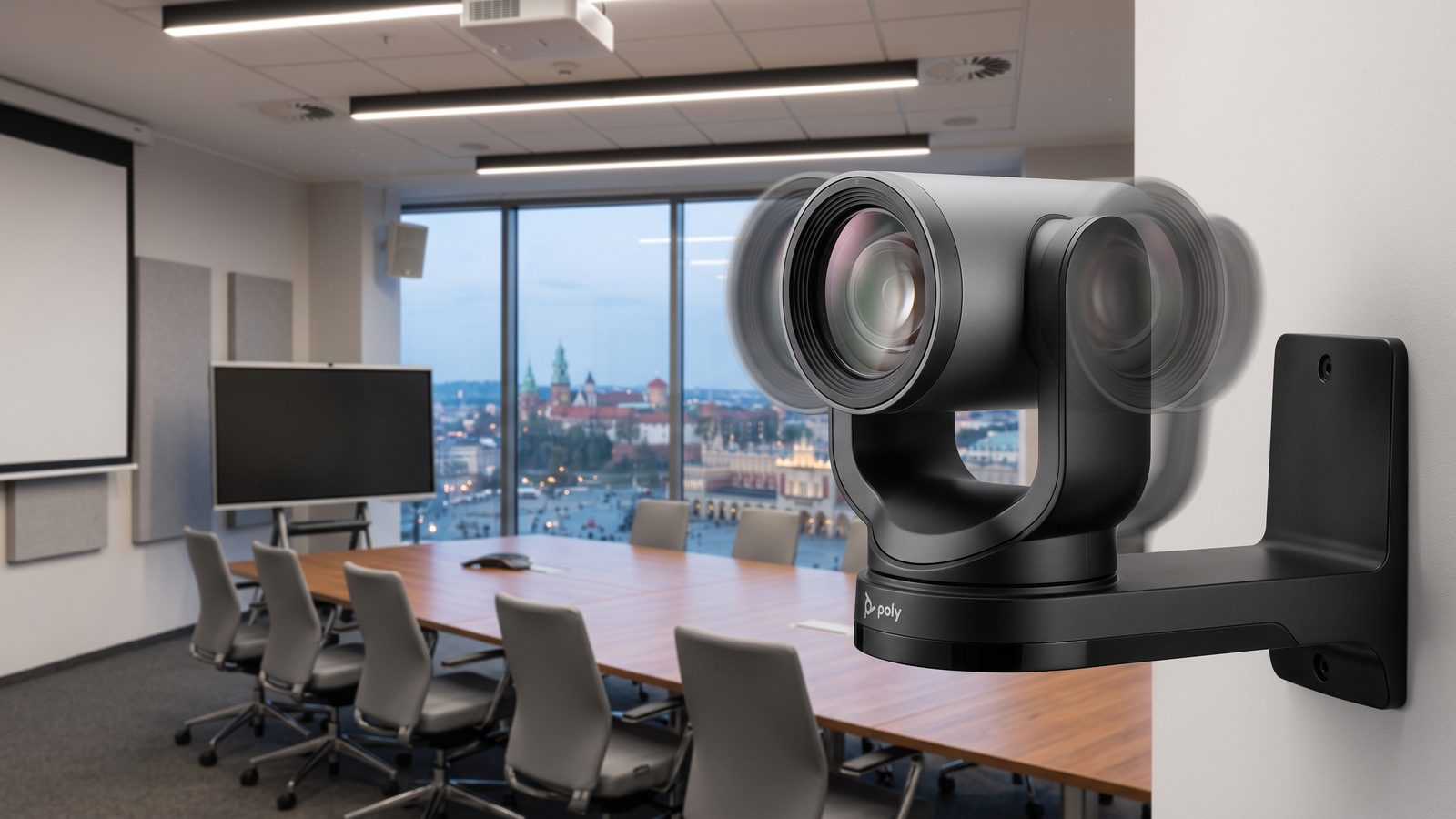
PTZ cameras have become one of the standard components of modern hybrid meeting rooms, where some participants are on-site and others join remotely. We explain how this technology works, how it differs from a regular conference camera, and in which rooms using it makes the most sense.
What PTZ stands for
PTZ stands for Pan-Tilt-Zoom, the three movements the camera performs — horizontal rotation (pan), vertical tilting (tilt) and image magnification (zoom). Unlike a stationary conference camera with a fixed, wide field of view, a PTZ camera can be controlled remotely, manually or automatically, so the frame follows whoever is speaking or covers a chosen part of the room.
How speaker tracking works
Modern PTZ cameras use voice and image recognition algorithms that automatically frame whoever is currently speaking — the camera pans and zooms toward them without an operator. Some systems combine several PTZ cameras with a central controller that decides which shot is best at any given moment, similar to a director running a live broadcast. This lets remote meeting participants see naturally changing shots instead of a static, wide view of the whole room.
When it makes sense to use a PTZ camera
- Hybrid rooms with active discussion — when many participants speak, automatic tracking significantly improves the meeting experience on the remote side.
- Large conference and boardrooms — a fixed, wide-angle camera can't capture facial detail from a great distance; a PTZ camera with zoom handles this well.
- Training and lecture rooms — the ability to track a presenter moving around the room or by a whiteboard.
- Corporate event broadcasts and recordings — flexible framing close to a TV-style production, without needing to hire a camera operator.
What to consider when choosing
When choosing a PTZ camera, it's worth considering the optical zoom range, performance in lower light, and the control method — some models integrate directly with video conferencing platforms and switch shots automatically, others require a dedicated controller or software. The number of cameras in the room matters too — a single PTZ camera works great in small and medium rooms, while large boardrooms or amphitheatre-style training rooms often use several cameras working together to cover different zones of the space.
Summary
A PTZ camera is an investment that makes sense wherever meetings are dynamic and remote participants should see more than just a static, wide shot of the whole room. In smaller rooms with a single, fixed speaker position, a simple conference camera can be enough — the decision should be based on how the room is actually used, not just its size.
Read also: PTZOptics