
In short: From choosing a projector to picking an outdoor screen — how to plan a summer cinema in your garden.
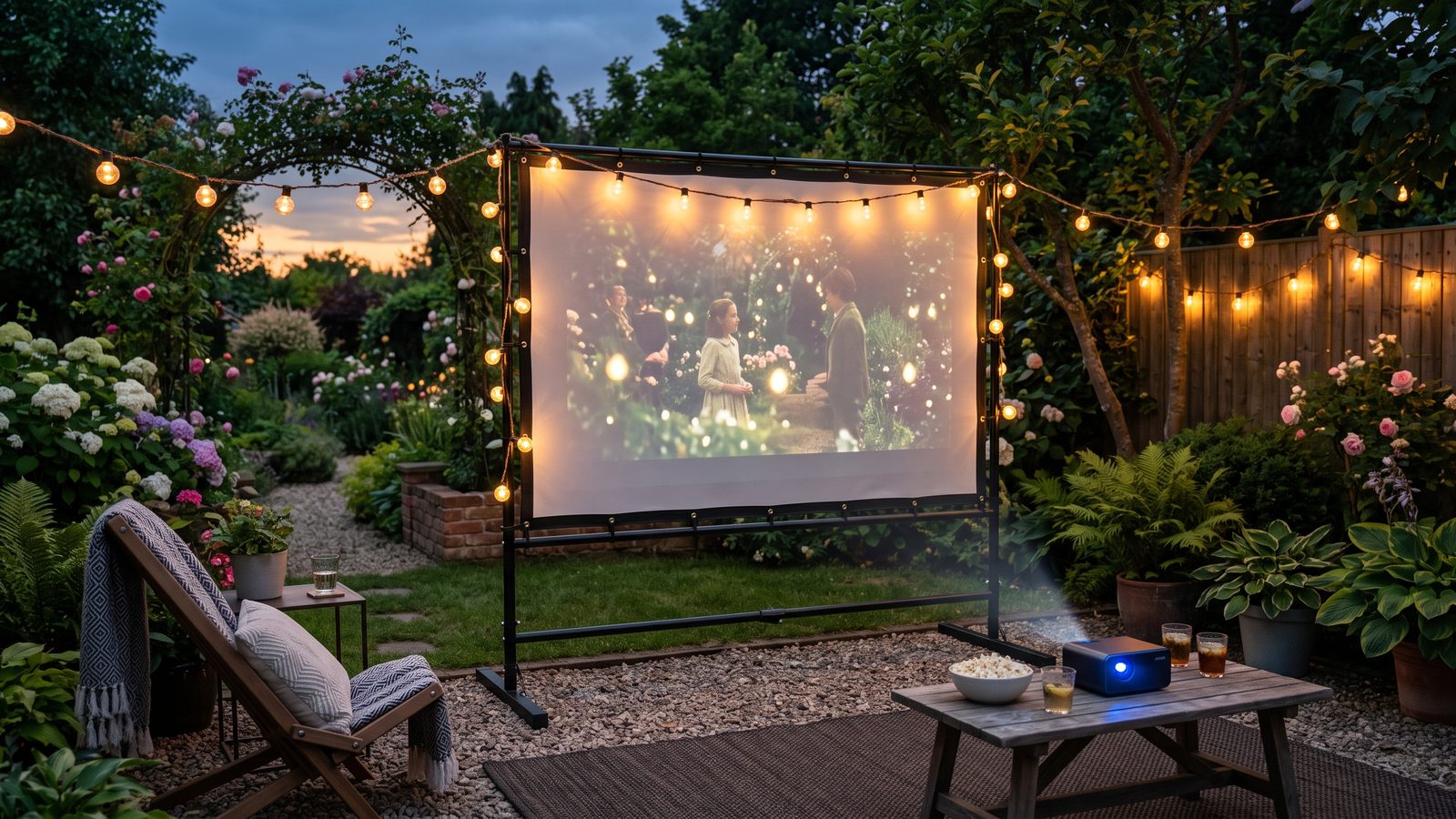
Summer evenings in the garden are a natural opportunity to create an outdoor cinema — all you need is a screen, a projector, and a bit of planning. The catch is that equipment designed for a dark room behaves quite differently under the open sky, where even dusk can be brighter than a blacked-out living room. This guide covers what to look at so your garden cinema works reliably, season after season.
A Projector Matched to Outdoor Conditions
Brightness is the key parameter — outdoor projection almost always takes place in conditions far from total darkness, even after nightfall, due to street lighting, neighboring windows, or ambient sky glow. Plan for a clear brightness margin above what would be enough in a blacked-out room. The second consideration is projection distance — in a garden it's rarely possible to place the projector exactly where the throw ratio would call for, so it's worth planning the mounting spot or tripod position in advance, taking the actual geometry of the plot into account.
- Portable projector — convenient, since it can be stored away after the season, but it needs to be set up and leveled every time.
- Permanent installation under a canopy — more convenient for everyday use, but it requires planning power supply and moisture protection in advance.
Outdoor Screen — What to Choose
For a garden, frame screens that unroll on a stand (stretched between posts or on a portable frame) and inflatable screens, popular at larger outdoor events, both work well. Material matters — it should resist moisture and not deform in the wind, since even small folds in the surface hurt image quality far more than they would indoors. The background color (white, gray) affects perceived image contrast — it's worth choosing it deliberately rather than by chance.
Sound in an Open Space
A garden has no walls to reflect and focus sound the way an indoor room does — acoustic energy scatters in every direction, so speakers for a garden cinema need noticeably more power than the size of the "audience" alone would suggest. Weatherproof wireless speakers positioned closer to the viewers than in a typical home cinema layout work well, along with a subwoofer, which loses the most energy in an open space and needs the most support.
Rule of thumb: outdoors, it's better to place speakers closer to the audience and a bit more powerful than to count on sound "carrying" as well as it does in a closed room.
Power Supply and Installation Safety
Electronic equipment in a garden needs protection from moisture — both the devices themselves (enclosures, outlets with an appropriate protection rating) and the way cabling is routed, which shouldn't lie directly on the grass or in spots where water can pool. If a permanent power point is planned for the garden, it should be installed in accordance with applicable electrical regulations, and it's worth consulting an electrician about residual-current protection where needed — safety in outdoor installations matters just as much as picture or sound quality.
Summary
A successful garden cinema is the result of several decisions working together: a projector bright enough for the conditions, a screen that's stable and weather-resistant, sound tailored to an open space, and a safe power supply. Planning these elements before the season starts means you can enjoy your summer screenings without accidental compromises.
Read also: ProjectorCentral