
In short: Screen type affects image quality just as much as the projector itself — we cover the available options.
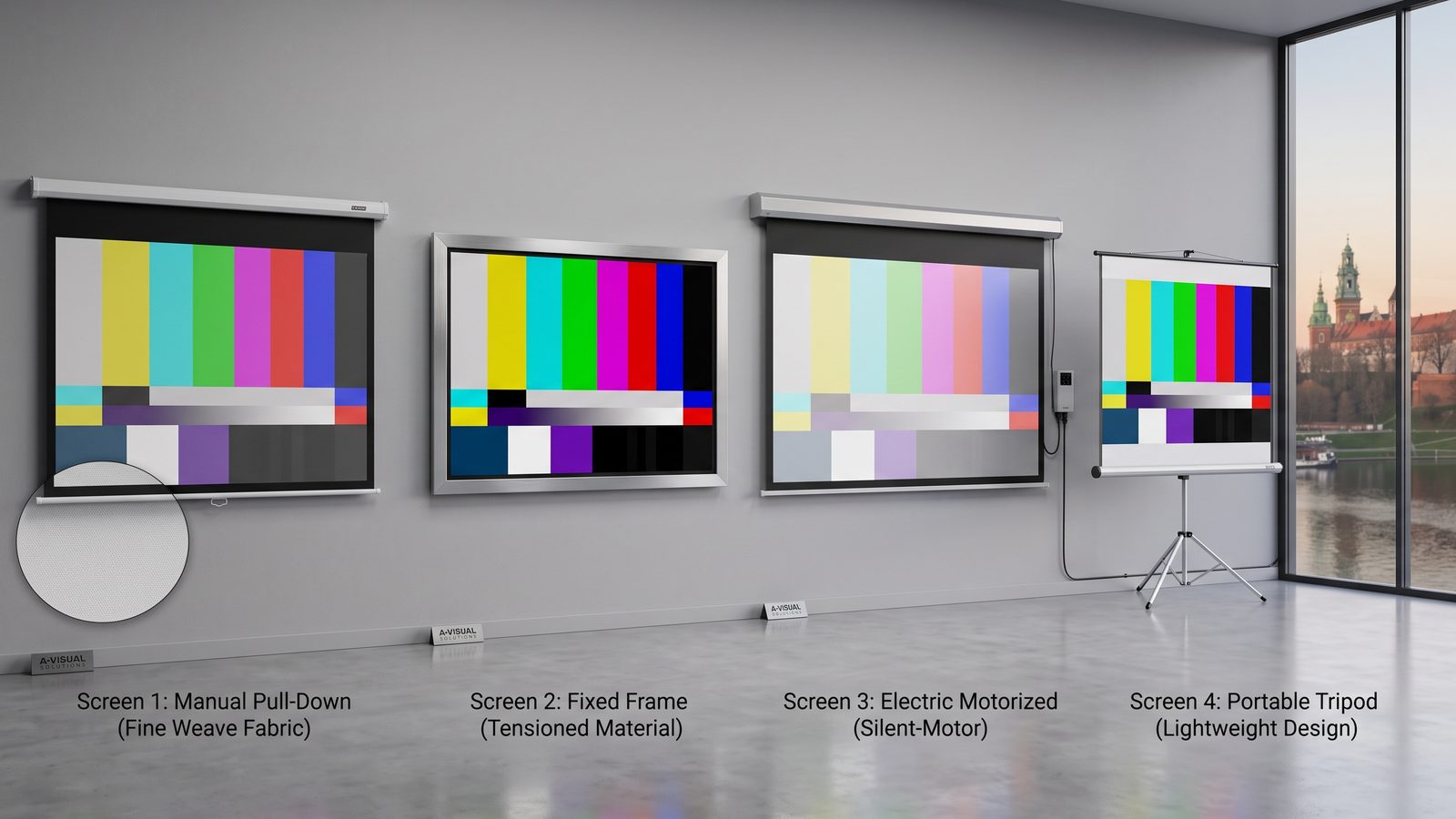
Choosing a projector usually gets the most attention when planning an AV installation, and the projection screen itself tends to be treated as an afterthought. Yet the type of surface the image falls on affects picture quality just as much as the projector's own specifications — even the best hardware displayed on the wrong screen won't show what it's capable of. We go through the available screen types and their typical applications.
Screen fabric — more than just a white surface
Projection screen fabric differs mainly in what's called gain — its light-reflection coefficient — and the angle at which the reflected light remains visible to viewers. Higher-gain screens give a brighter image on the central viewing axis but narrow the angle from which the image looks optimal — which matters in wide rooms where participants sit at varying angles relative to the screen. A separate category is fabric designed for bright-room use, engineered to limit the impact of ambient light on image contrast — worth considering in rooms without full blackout capability.
Frame screens — a fixed projection surface
A frame screen is fabric stretched over a rigid structure, permanently wall-mounted. The advantage of this solution is a perfectly flat, unchanging projection surface, free of the folds and unevenness that can appear in roll-up screens. It's a good choice for rooms where the projector runs regularly and there's no need to hide the screen away when not in use — for example dedicated conference or training rooms.
Electric screens — convenience at the cost of extra installation
An electric screen retracts into a housing mounted in the ceiling or on the wall and extends automatically, usually controlled by a remote or integrated with the room's control system. This solution works well in multipurpose rooms, where the projection space needs to give way to other room functions when the screen isn't needed. It requires additional power and space for the housing, which is worth factoring in already at the room design stage, not after finishing work is complete.
Portable screens — flexibility without permanent mounting
Portable screens, on a tripod or rolled into a carrying case, work well wherever presentations happen in different locations, or the room has no fixed purpose for projection — for example at events, off-site training or in shared spaces. The cost of that flexibility is usually a less stable surface and having to set up the screen every time, which becomes impractical in rooms used daily.
Summary
Choosing a projection screen should follow from how often and in what way the room is used — a fixed, regularly used conference room benefits from a frame or electric screen, while a multipurpose space or equipment used across different locations is better served by a portable solution. A well-chosen fabric, matched to the room's lighting conditions and viewing angle, can improve the received image more than its seemingly secondary role in the whole installation would suggest.
Read also: ProjectorCentral