
In short: We compare the two most popular installation options for aesthetics, cost and sound quality.
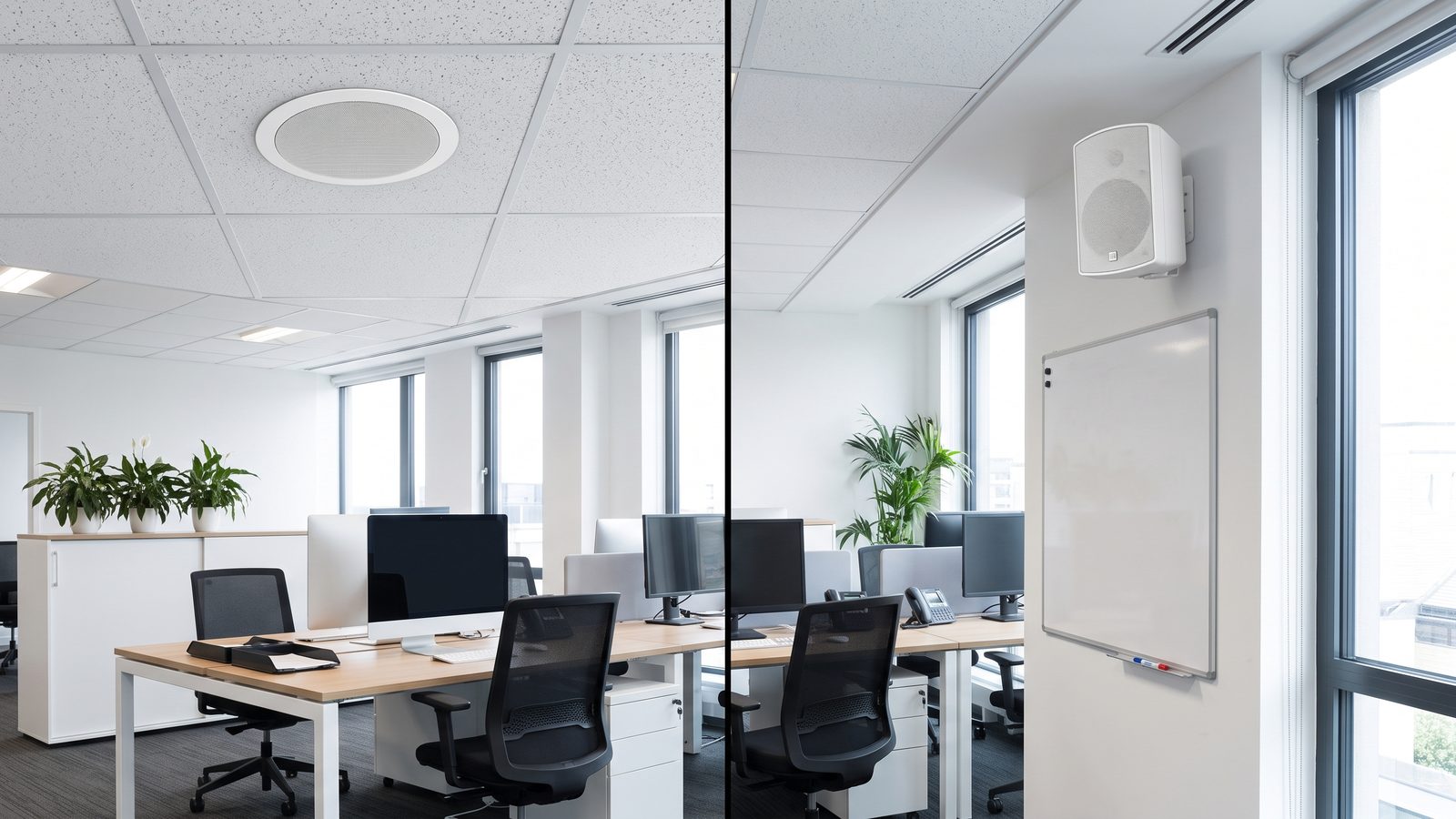
When planning sound reinforcement for an office, conference room or open-plan space, the question arises which solution works better: ceiling speakers or wall-mounted speakers. The answer depends not only on budget, but also on ceiling construction, the character of the room and how important it is for the equipment to be completely invisible.
Ceiling speakers
Mounted in a suspended ceiling, in-ceiling speakers are practically invisible — from floor level, only a small grille is visible. This solution is popular in modern offices where interior aesthetics matter and the interior designer doesn't want extra elements appearing on the walls.
Another advantage of ceiling speakers is even sound coverage across a large area when several points are spaced appropriately — sound "flows down" from above across the whole room, which works well in open-plan spaces and corridors. The downside is the need to work into the suspended ceiling structure, and in rooms with high or unusual ceilings, sound quality and directionality can be harder to control.
Wall-mounted speakers
Wall-mounted speakers are simpler to install — no work on the ceiling is needed, and they suit rooms without a suspended ceiling, for example those with a concrete slab or a tall structure. They also give more control over the direction sound travels, which is useful in irregularly shaped rooms where sound needs to be deliberately aimed at the zones where people sit.
On the other hand, wall-mounted speakers are visible, which some office clients consider less elegant, especially in prestigious meeting rooms.
Practical comparison
- Aesthetics — ceiling speakers win on invisibility; wall-mounted units are noticeable, though modern models have a discreet, minimalist enclosure.
- Installation cost — wall mounting is often cheaper and faster, especially where there's no suspended ceiling to make ceiling speaker installation easy.
- Sound directionality — wall-mounted speakers are easier to "aim" at a specific zone of the room; ceiling speakers give more diffuse, general coverage.
- Layout flexibility — in rooms where furniture layout changes often, ceiling speakers deliver more even sound regardless of how the tables are arranged.
Rule of thumb: in rooms with a suspended ceiling and a requirement for full aesthetics, ceiling speakers usually work best, while wherever precise sound direction matters or the ceiling prevents mounting, a wall-mounted solution is worth considering.
Summary
There's no single universal answer to which solution is better — the decision should follow an analysis of the room's construction, aesthetic expectations and how the room is used. In many office installations, both solutions are combined within the same building, chosen separately for the character of each room.
Read also: Bose Professional