
In short: Line array systems dominate large events — we explain how they work and their typical uses.
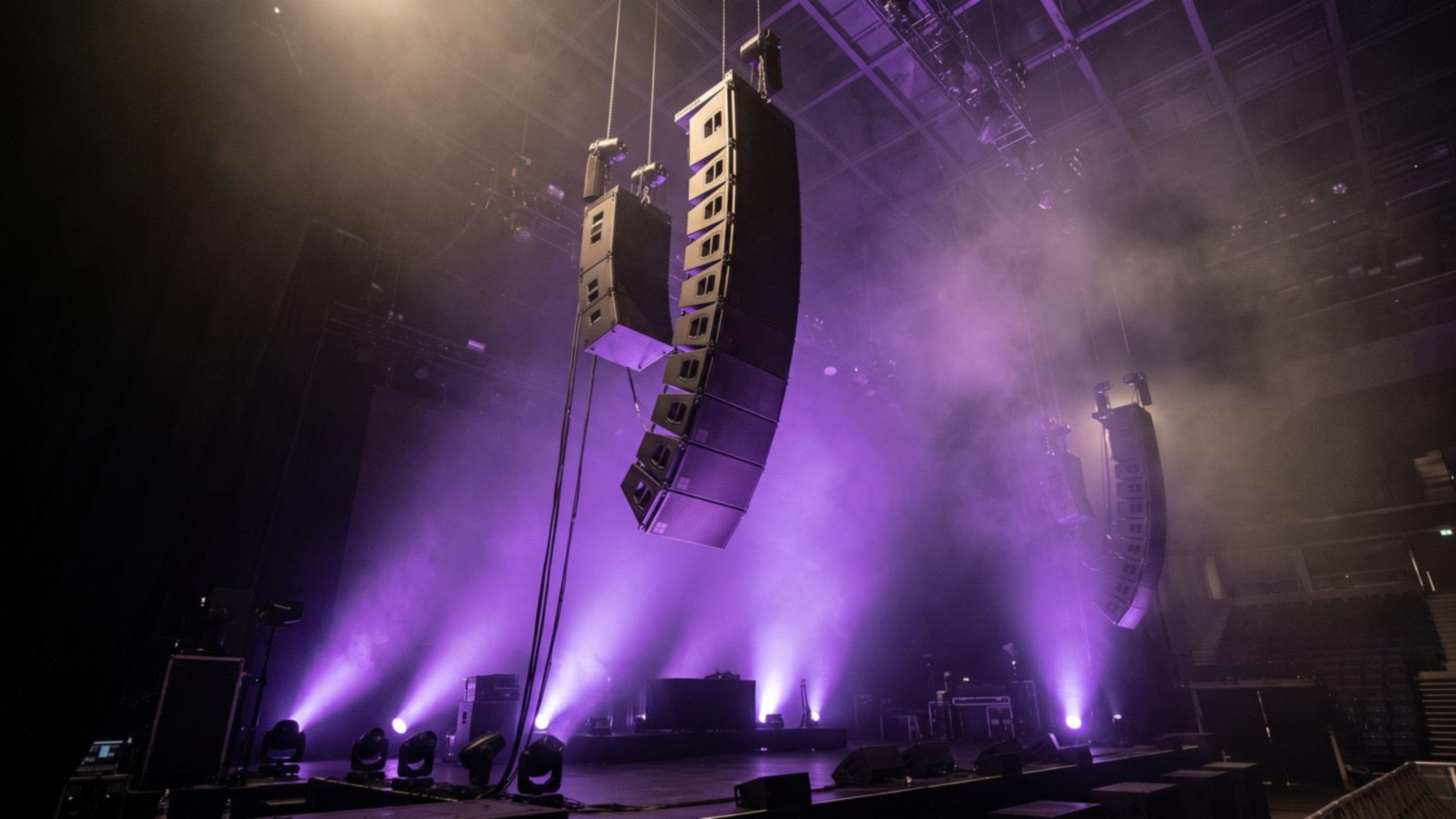
Line array systems have long been the standard at large concerts, conferences and outdoor events — for good reason, since they can cover large, irregular spaces in a way that single point-source speakers simply cannot match. In this article we explain how they work and offer guidance on when this solution is worth using, and when it is an unnecessary case of form over substance.
Operating principle — why several speakers stacked vertically make a difference
A line array is a set of many identical speaker modules suspended one above another in a vertical line, designed so that the sound waves emitted by neighbouring modules combine with each other. With the right splay angle between elements, the result is a single, coherent "wall of sound" that propagates differently than a wave from a single point-source speaker — it loses energy more slowly with distance and allows much more precise control over where the sound goes and where it doesn't.
That control over the direction of propagation is the key point: a well-designed line array can be "aimed" to cover the audience from the first row to the last at a relatively even sound level, while limiting sound reflecting off the ceiling or the back wall.
Types of line array systems
- Large concert systems — multi-module rigs flown from trusses, used at concerts, festivals and large conferences that need to cover audiences of hundreds or thousands of people.
- Column line arrays — smaller systems, often placed on stands or wall-mounted, popular in multifunctional halls, churches, auditoriums and medium-sized conference rooms.
When it makes sense to use a line array
Line array is most valuable where a large, elongated space needs sound coverage with a limited number of mounting points — auditoriums, lecture halls, large conference rooms or outdoor spaces. It also excels where an even sound level between the first and last row of the audience matters, without having to add many extra fill speakers.
In smaller rooms — up to a few dozen people — a line array can be an unnecessary overkill in cost and complexity. A simpler system built from one or two point-source speakers, well matched to the room's volume, often achieves a comparable or better result at a lower installation and service cost.
Rule of thumb: if the farthest listener sits many metres from the speaker, or the room has an unusual, elongated shape, a line array is worth considering — in most other cases, a well-chosen point-source system is enough.
Summary
Line array is a powerful tool, but — like any tool — it works best where it actually answers a real problem: a large, acoustically challenging space that needs even sound coverage over a long distance. Choosing the right configuration, module splay angle and hanging points is a job for an acoustic designer, because mistakes made at this stage are hard to correct later with DSP settings alone.
Read also: ProSoundWeb