
In short: Feedback is the most common problem in poorly designed audio installations — we show how to prevent it.
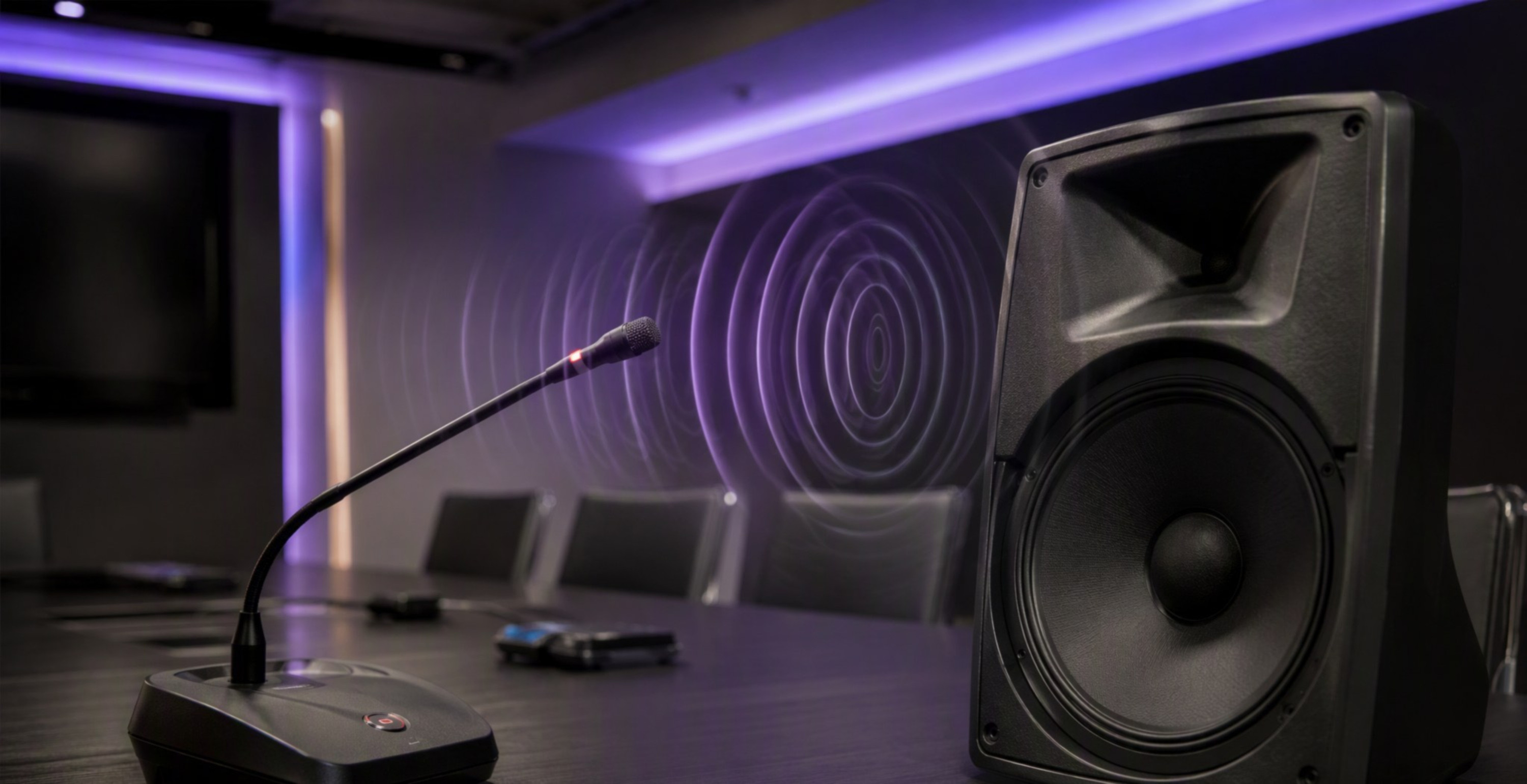
That distinctive, piercing squeal suddenly blasting from the loudspeakers is one of the most unwelcome things that can happen during a meeting or presentation. Acoustic feedback isn't an equipment fault — it's the result of a poorly designed or poorly tuned audio installation, and in the vast majority of cases it can be effectively prevented as early as the planning stage.
What feedback is and why it happens
Acoustic feedback occurs when sound emitted by a loudspeaker reaches the microphone, gets amplified and played back again, and the cycle repeats — creating a positive feedback loop that builds up within a fraction of a second into an audible, unpleasant sound. The more energy from the speaker reaches the microphone relative to the energy of the speaker's voice, the easier feedback occurs.
The most common causes of feedback
- Speakers placed too close to microphones — a classic mistake, where a speaker sits directly in a microphone's pickup axis or too near it.
- Excessive gain — an overly high microphone input level narrows the margin before feedback appears.
- Hard, reflective surfaces — glass, concrete and other hard materials reflect sound from the speakers back toward the microphones instead of absorbing it.
- Incorrect microphone directionality — an omnidirectional microphone placed near a speaker "hears" more than it needs to, unlike a cardioid microphone deliberately aimed at the speaker.
- No DSP with feedback suppression — without automatic detection and attenuation of problematic frequencies, manual system tuning rarely produces a lasting effect.
How to prevent feedback
The foundation is proper equipment placement at the design stage — loudspeakers and microphones should be spatially separated, and microphone directionality chosen so it deliberately "ignores" sound coming from the direction of the speakers. Equally important is correct gain structure — setting signal levels at every stage of the audio chain so that no device operates on the edge of overload.
A DSP with automatic feedback suppression additionally monitors the signal in real time and attenuates the narrow frequency bands where feedback starts to build — before it becomes audible. This solution, however, does not replace good equipment placement; it only safeguards the system in more difficult acoustic conditions.
The acoustics of the room itself also matter — rooms with plenty of hard, parallel surfaces encourage reflections that make feedback easier to trigger even with correctly placed equipment.
Rule of thumb: if a room "squeals" repeatedly despite correct volume settings, the problem usually cannot be solved by turning things down — you need to re-examine equipment placement and room acoustics from scratch.
Summary
Acoustic feedback is, in practice, a signal that one of the elements of the setup — equipment placement, gain settings or room acoustics — needs correcting. A professional installation accounts for these factors from the outset, so feedback becomes a problem that practically never occurs, rather than something that has to be masked at every meeting.
Read also: Sweetwater inSync