In short: The digital signal processor is the heart of modern sound systems — we explain its real-world value.
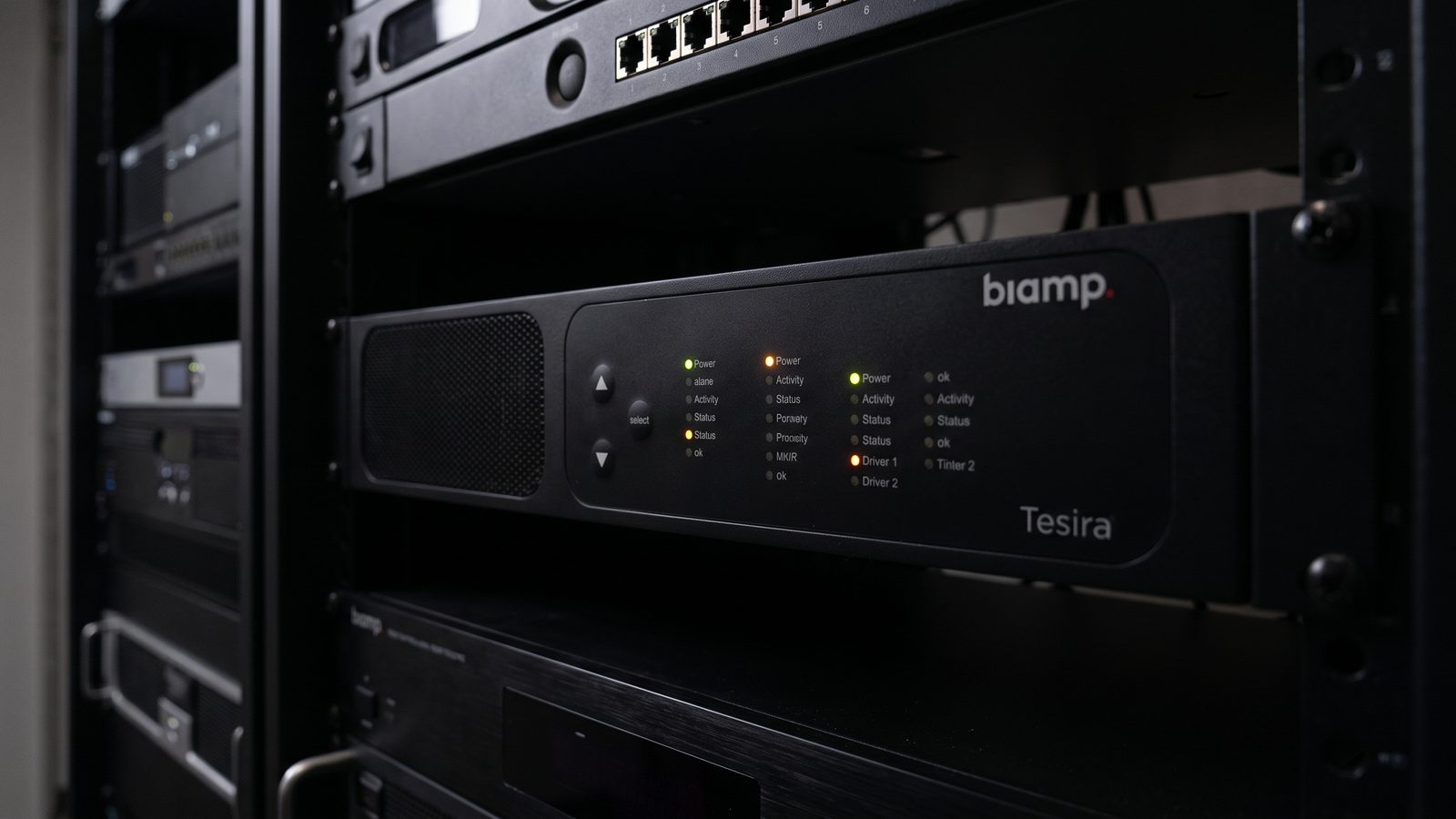
A DSP, or digital signal processor, is a component of a sound reinforcement system that rarely draws attention, yet often determines whether an audio installation sounds professional or merely "good enough." Sitting between the audio sources and the amplifiers, a DSP handles dozens of operations that used to require separate, analogue devices. In this article we explain what it actually does and why it belongs in every serious installation.
What a DSP does in practice
A DSP processes the audio signal digitally before it reaches the amplifiers and loudspeakers. A single device houses functions that once required a separate equalizer, compressor, limiter and crossover processor.
- Equalization (EQ) — tuning the sound to the acoustics of a specific room and the characteristics of the installed loudspeakers.
- Digital crossover — splitting the frequency band between subwoofers, low-frequency and high-frequency drivers.
- Limiter and compressor — protecting loudspeakers from overload and damage at excessive signal levels.
- Delay — time-aligning loudspeakers placed at different distances from the listener, so sound arrives at the ear simultaneously.
- Feedback suppression and echo reduction — automatically detecting and attenuating frequencies responsible for acoustic feedback, essential in conference rooms with microphones.
Why it is worth having a DSP in the installation
The biggest benefit of a DSP is repeatability and equipment protection. Once properly configured, a processor ensures the system sounds equally good every day — regardless of who operates it — while also protecting loudspeakers and amplifiers from damage caused by human error, such as turning the volume up too abruptly.
A second major advantage is the ability to programme ready-made scenes (presets) — one setting for presentations, another for video conferencing, another still for a live performance. Changing the room's mode of operation then comes down to pressing a single button instead of manually retuning the entire system.
When a DSP is especially needed
In small, one-off installations with a single source and a single pair of speakers, the need for a DSP may be limited. But in any multi-zone installation, in rooms with microphones and a video conferencing system, and wherever the system has to support different usage scenarios, a DSP stops being an add-on and becomes the central element of the setup.
Rule of thumb: if an installation has more than one loudspeaker zone, or even a single microphone working in the same room as the speakers, a DSP with auto-mixing and feedback suppression quickly pays for itself through fewer service callouts.
Summary
A DSP is an investment whose effects aren't obvious at first glance, but are audible in every detail of how the system performs — from sound clarity, through equipment protection, to day-to-day ease of operation. In modern AV installations it is no longer treated as an option, but as a standard part of the design.
Read also: Biamp Cornerstone