
In short: How to connect AV systems with building management so they work as one coherent whole.
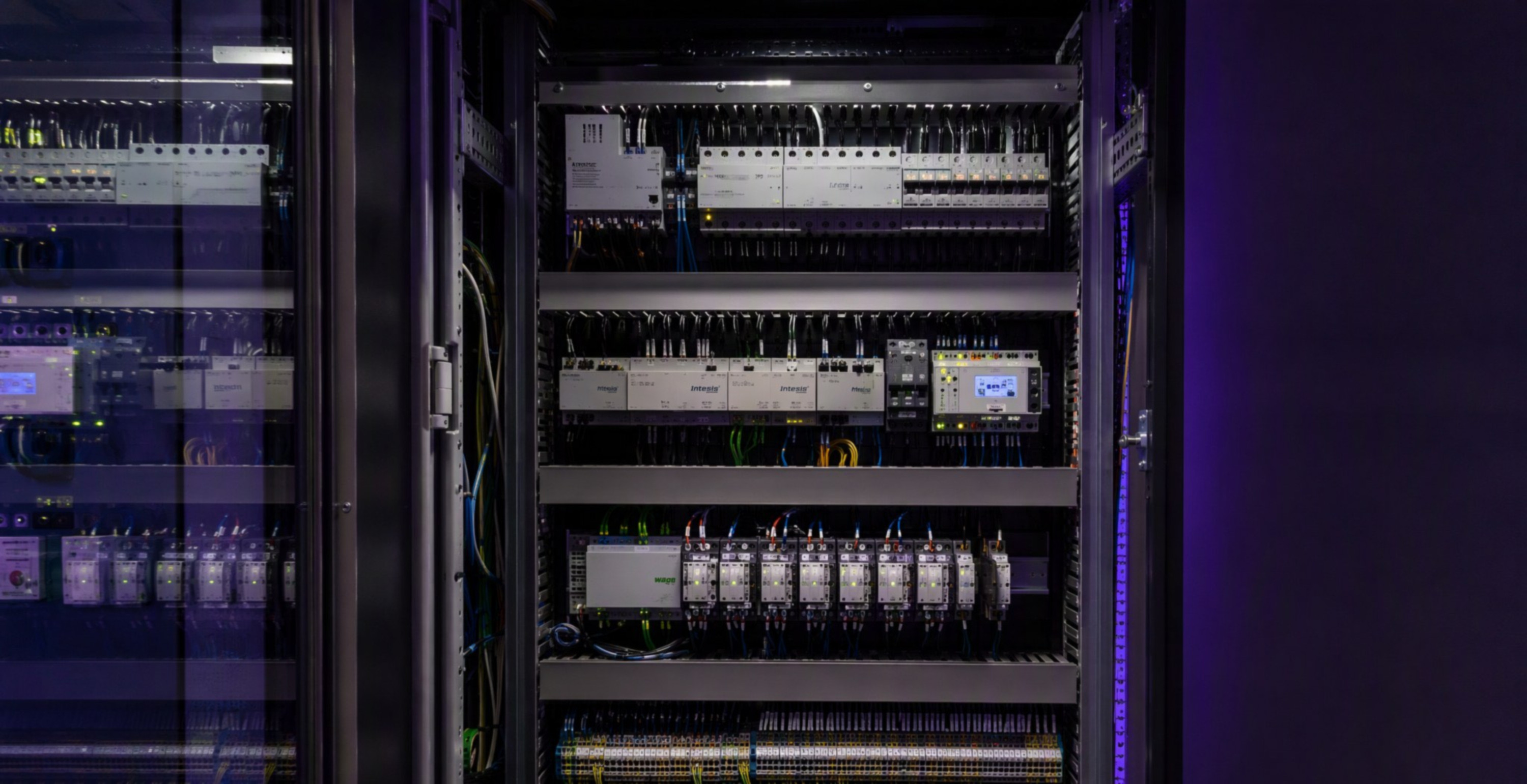
In modern office buildings, an AV system rarely operates in isolation from the rest of the building today — lighting, air conditioning, blinds, or access control. Integration with a BMS (Building Management System) makes it possible to treat all these elements as one coherent whole, controlled and monitored from a single place. In practice, though, this kind of integration is often one of the trickier stages of a project, so it's worth understanding what it involves and what it delivers.
What a BMS Is and How It Connects to AV
A BMS handles the management of a building's technical systems — heating, ventilation, air conditioning, lighting, blinds, and security systems. Integrating it with AV means that a conference room, when its presentation system starts up, can simultaneously dim the lights, lower the blinds, and adjust the air conditioning to the number of people in the room automatically — without anyone having to control each element by hand. Communication between the systems typically happens over standard building automation protocols or through dedicated integration modules supplied by AV equipment manufacturers.
Benefits of Integration
- A single point of control — the user operates the room from one panel instead of controlling lighting, blinds, and AV equipment separately.
- Automated scenarios — starting a presentation can automatically trigger a pre-set scene: dimmed lights, lowered blinds, projector turned on.
- Energy efficiency — the system can power down AV equipment and lighting in rooms that are currently unoccupied, based on data from occupancy sensors.
- Easier management of multiple rooms — the building administrator can see the status of every room from a single dashboard, without having to physically check each one.
Technical Challenges of Integration
The biggest difficulty tends to be the variety of protocols and standards used by different manufacturers — a BMS already installed in a building doesn't necessarily "understand" the AV equipment chosen for a specific room right out of the box, especially if it comes from a different manufacturer or was installed at a different time. That's why integration is best planned at the AV system design stage, rather than bolted on afterward to a finished, closed installation. It's also worth deciding upfront who's responsible for configuring and maintaining the integration — the AV installer, the BMS supplier, or the building's IT department — to avoid a fault getting stuck between vendors.
Rule of thumb: factor AV-BMS integration into the technical design phase, not as an afterthought — this lets you choose equipment that can actually be connected to the existing building automation.
When Integration Makes Sense
Full AV-BMS integration pays off primarily in larger facilities, with many conference rooms and extensive building automation, where centralized management genuinely saves administrators time and cuts down on service calls. In smaller offices with a single meeting room, a simpler AV control system running independently of the BMS is often sufficient and cheaper to implement.
Summary
Integrating AV systems with building automation creates a coherent, convenient working environment in which presentation equipment, lighting, and air conditioning work together automatically. The key to a successful implementation is planning this integration from the very start of the project, rather than trying to connect two independently designed systems at the end.
Read also: Crestron