
In short: Beamforming lets a microphone “follow” the speaker's voice — we explain how this technology works.
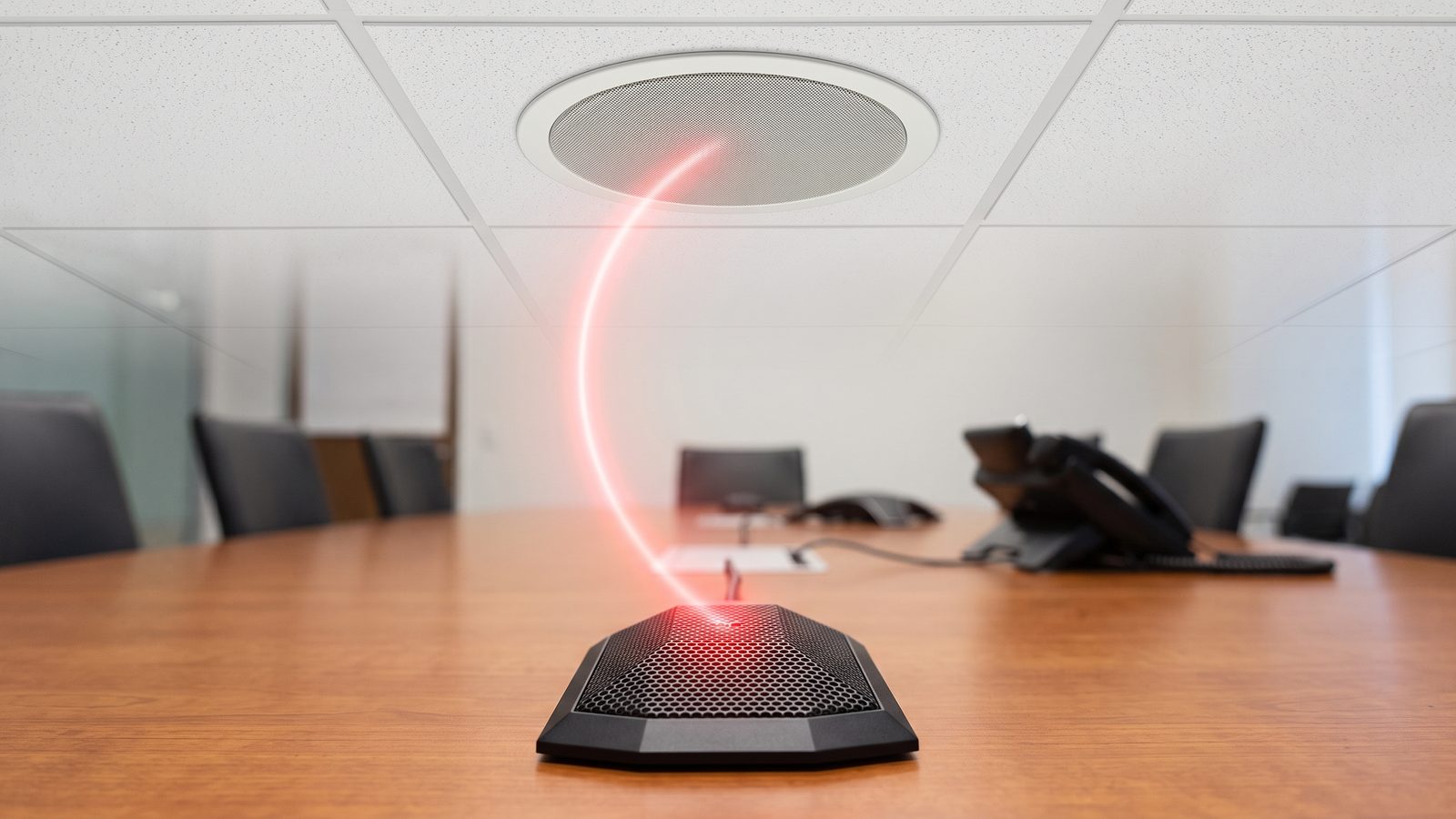
New-generation ceiling microphones can "follow" the voice of whoever is speaking, even though they have no moving parts at all. They owe this effect to beamforming technology — digital signal processing that steers the microphone's sensitivity toward wherever someone is currently speaking. We explain how it works and why it matters so much for sound quality in conference rooms.
How beamforming works
Instead of a single capsule, a beamforming microphone contains an array of many small microphones (a mic array) arranged in one housing. The signals from the individual capsules are processed digitally and combined so that sound arriving from a particular direction is boosted while sound from other directions is suppressed. In practice, the processor "draws" a narrow beam of sensitivity aimed at the person speaking — hence the name beamforming, literally "shaping a beam."
When the voice starts coming from a different spot in the room, the algorithm switches or shifts the sensitivity beam in real time, so the microphone always "follows" whoever is currently speaking, with no need to manually switch channels or move closer to a fixed point.
Why this matters in practice
- Better voice clarity — focusing sensitivity on the sound source improves the signal-to-noise ratio, producing clearer, more intelligible audio, especially for remote meeting participants.
- Background noise suppression — sounds outside the beam, such as HVAC noise, corridor noise or rustling papers, are automatically reduced.
- No need to lean toward the microphone — participants can speak freely from anywhere within the microphone's range, without leaning over the table.
- Installation aesthetics — ceiling microphones are invisible, eliminating the need to place microphones on the table.
Limitations of the technology
Beamforming, while effective, doesn't work in isolation from the room's acoustics. In a room with long reverberation or plenty of hard, reflective surfaces, the algorithm has a harder time distinguishing direct sound from its reflections, which can reduce speaker-tracking accuracy. For this reason, beamforming ceiling microphones perform best combined with adequate acoustic treatment of the room, rather than as a standalone fix for acoustic problems.
Correct calibration after installation also matters — the microphone's position relative to the table, ceiling height and the layout of microphone zones should be tuned individually for each room, usually through the manufacturer's configuration software.
Rule of thumb: beamforming improves speech clarity, but it doesn't replace good room acoustics — in heavily reverberant rooms, pair it with acoustic panels to get the full effect.
Summary
Beamforming technology has changed how conference room sound reinforcement is designed, enabling fully invisible microphones without sacrificing audio quality. It is, however, a solution that requires thoughtful installation and appropriate room acoustics to reach its full potential.
Read also: Shure MXA920